
Perth Amboy Elite Roofing provides flat roof repair in Perth Amboy, NJ, serving surrounding cities including South Amboy, Metuchen, South River, Highland Park and Roselle Park. Many of the city’s two-family houses pair a pitched front roof with a low-slope rear section, and after 20+ years on those roofs we know the rear is usually where the leak calls come from.
A flat roof leak is rarely where the patch is. We check every low-slope roof at its seams, its edge metal and its drain or scupper, not just at the spot someone sealed last time. Then we tell you whether a repair will hold, or whether the insulation underneath is wet enough that it will not.
Flat Roofs on Two-Family Houses and Rentals
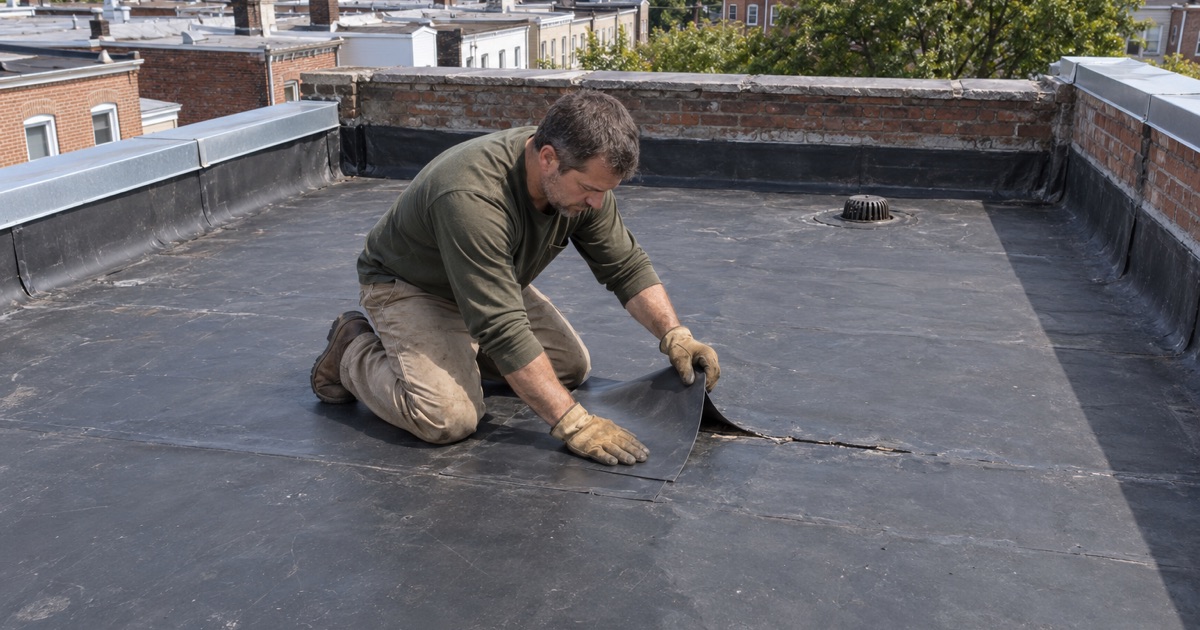
The Rear Section Behind a Pitched Front
The low-slope rear roof often covers a kitchen, a bathroom or an enclosed back porch on each floor. Because it drains slowly and sits below the main roof, it takes the water from both, and the joint where it meets the pitched front is a frequent leak point. A tenant’s ceiling stain in the back room is often the first sign.
The Joint Between the Two Roofs
Where the flat roof meets the shingled slope, the membrane has to run up under the shingles far enough that water from the main roof lands on top of it. When the shingles were simply laid over the edge of the flat roof, water from the slope runs underneath the membrane instead. We rebuild that transition with membrane, flashing and new shingles so the two roofs shed water in the right order.
Porch Roofs and Small Additions
Front and rear porch roofs are often nearly flat, covered with roll roofing or a single-ply membrane, and tied into the wall of the house with a strip of flashing. Rotting porch ceilings and stained porch columns usually trace back to the wall flashing or the edge where water drips into the gutter. We repair those details so the porch stops leaking without replacing the entire roof.
Repairs With Tenants Below
On a rental, the rooms under a flat rear roof are usually someone’s kitchen or bedroom. We tell the tenants when the crew is coming and whether we will need to see the ceiling from inside, and torch work is planned with extra care over occupied space. Owners get a short written note of what was repaired, which helps when the same tenant reports a stain again.
Built-Up and Roll Roofing on Older Houses
Some older rear sections still carry built-up roofing with gravel, or mineral-surfaced roll roofing nailed in overlapping strips. Both can be patched for a while, but roll roofing in particular has a short life on a nearly flat surface. When we find it, we tell you how long a repair is likely to last compared with replacing it with a modern membrane.
Repairs by Membrane Type
Modified Bitumen Seams and Blisters
Torch-down SBS and APP modified bitumen fails most often at laps that were not fully bonded and at blisters where moisture was trapped. We cut out blisters, let the area dry, and torch new cap sheet over the repair with overlaps wide enough to bond securely. Where granules have worn off and the asphalt is exposed, a cap sheet patch or coating protects it from the sun.
EPDM Rubber Repairs
EPDM rubber usually fails at its seams and around pipes and vents, where the adhesive or flashing ages before the rubber does. We clean and prime the surface, then apply EPDM seam tape and cover patches made for the membrane. Glue alone or roofing cement on EPDM does not bond well, so we avoid them as a permanent fix.
TPO and PVC Repairs
TPO and PVC membranes are repaired with heat-welded patches that fuse to the existing sheet. Punctures from dropped tools or service technicians are common on these roofs, along with seams that were under-welded at installation. A proper weld makes the patch part of the roof rather than something stuck on top of it.
Edges, Drains and Ponding Water
Edge Metal and Drip Edge
The perimeter is where wind gets under a flat roof. Loose or bent edge metal lets wind lift the membrane, and once the edge peels back, every storm pulls it further. We re-secure or replace the edge metal, seal the membrane to it and make sure the edge directs water into the gutter or off the building.
Scuppers and Roof Drains
Small flat roofs often drain through a single scupper or a short gutter at the back. Leaves and debris block it, water rises over the seams, and a small defect becomes an active leak. We clear the outlet, reflash it into the membrane and check that the leader below runs freely.
Fixing Ponding
Where water stands for days, we look for the cause: a low spot in the deck, a sagging joist or a drain set too high. Small low spots can sometimes be built up during a repair. Larger ponding areas usually need tapered insulation or an added drain, which is done when the roof is rebuilt.
When a Repair Will Not Last
Wet Insulation Under the Membrane
A flat roof that feels soft or spongy underfoot almost always has wet insulation beneath it. Water trapped there spreads, rots the deck and makes every patch fail from below. We check the extent of the wet area before recommending a repair, and if it is widespread we say so.
Repair, Recover or Rebuild
If the problem is local, a repair is the right answer. If seams are failing across the whole roof, a recover over a single dry layer may be an option. If there are already two layers or the insulation is wet, New Jersey’s re-roofing rule and common sense both point to a tear-off and rebuild, and our written scope breaks that work into separate lines so you can compare it with any other estimate.
- 20+ Years in Roofing
- Itemized Written Estimates
- Attic-to-Roof Leak Tracing