
Perth Amboy Elite Roofing provides gutter installation in Perth Amboy, NJ, serving surrounding cities including South Amboy, Metuchen, South River, Highland Park and Roselle Park. After 20+ years on the city’s roofs, we treat gutters as part of the roof system rather than an accessory, because a roof that sheds water perfectly still fails if the water has nowhere to go.
We install seamless aluminum gutters and leaders on houses, two-family rentals and small commercial buildings, and we repair or replace the fascia and drip edge they depend on. Each run is sized to the roof area that drains into it and pitched so water reaches the outlet instead of standing in the trough.
The sections below explain how we size and hang gutters on houses, what changes on rental and commercial buildings, how gutters tie into a new roof, and the steps of a typical installation.
Residential Gutter Installation
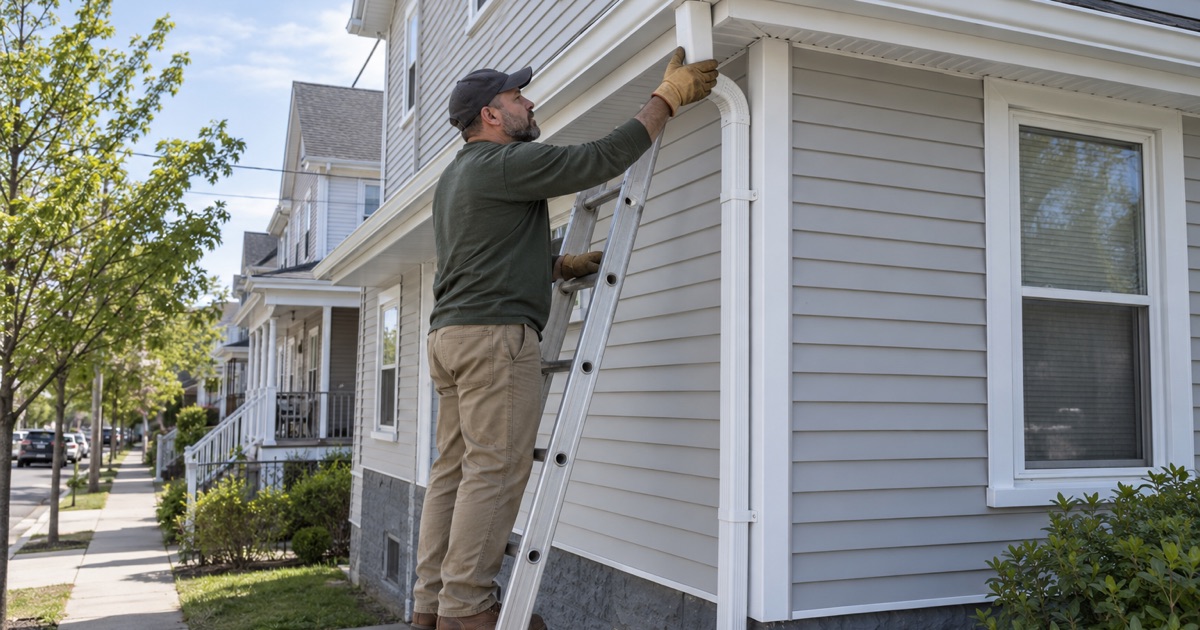
Seamless Aluminum Gutters
Seamless aluminum gutters are made in continuous lengths that run the full side of the house, so the only joints are at corners, end caps and outlets. Fewer joints mean fewer drips, and aluminum does not rust the way old steel gutters do. The common K-style profile looks like crown molding from the street and holds more water than a half-round gutter of the same width. We match the gutter color to the trim or the roof edge, so the new gutters disappear into the house rather than drawing the eye.
Sizing Each Run to the Roof
A gutter has to hold the water from every square foot of roof that drains into it, and steep roofs send water faster than shallow ones. On many houses the front and back slopes are very different sizes, and a dormer or valley can concentrate water at one point. We measure each run and choose a profile and the number of outlets to match, instead of fitting one size around the whole house. Where a valley empties into a gutter, a splash guard keeps water from overshooting the corner in heavy rain.
Pitch, Hangers and Fascia
Every gutter needs a slight, steady pitch toward its outlet. Too little and water stands in the trough, collecting debris and freezing in winter; too much and the gutter looks crooked and drops too low at the outlet end. We set the pitch with a string line and fasten hidden hangers into solid wood at close spacing so the gutter carries snow and ice without sagging.
Hangers are only as strong as the fascia behind them. Before installation we check the fascia board, replace soft or rotted sections and show you the damage, so the new gutter is not hung on wood that will fail in a few winters.
Leaders and Where the Water Goes
Leaders, or downspouts, carry the water from the gutter to the ground, and they need to be large enough and numerous enough to keep up with a heavy storm. We place them where the water can discharge away from the foundation, walkways and the neighbor’s lot, using extensions, splash blocks or connections to an existing drain line.
A leader that dumps onto a lower roof needs protection there, since concentrated water wears a channel through shingles and membranes. We route or protect those outlets so one fix does not create another leak.
Gutters on Two-Family and Rental Houses
Rear Roofs, Porches and Lower Sections
Two-family houses often have several roof levels: a pitched front, a low-slope rear, a porch roof and sometimes an enclosed back porch. Each level needs its own drainage, and water from an upper level has to be carried past the lower roofs rather than poured onto them. We plan the gutter and leader layout for the whole building, not one side at a time.
Low-slope rear roofs often drain through a scupper or to a short gutter at the back edge. Those outlets are small and easily clogged, so we size them generously and keep the edge metal tight to the gutter.
Working Around Tenants
Gutter work on a rental means ladders at windows and noise at the eaves. We let the tenants know when the crew will be there and which sides of the house we will be working on, and we keep walkways and entrances clear while the old gutters come down. At the end of each day the yard and sidewalk are cleaned, including a magnet sweep for nails and screws.
Commercial Gutters, Scuppers and Conductor Heads
Parapet Buildings and Scuppers
Many small commercial and mixed-use buildings have parapet walls instead of open eaves, so water leaves the roof through scuppers cut through the wall. A scupper drains into a conductor head, a box mounted on the outside of the wall that collects the water and feeds the leader. Each piece has to be flashed into the parapet and membrane, or water leaks into the wall around it. We size scuppers, conductor heads and leaders for the roof area behind them, and repair or replace the through-wall flashing where it has failed.
Storefronts and Sidewalk Drainage
On a storefront, gutters and leaders have to keep water off the sidewalk, the entrance and the sign. We route leaders down the building where they will not drip on customers, and connect them to the existing drainage where one exists. Work is scheduled so the store can stay open, with access kept clear for customers.
Installing Gutters With a New Roof
Drip Edge and the Gutter Line
Drip edge is the metal strip along the eaves that carries water off the shingles and into the gutter. If it stops short of the gutter or is missing entirely, water runs down behind the gutter onto the fascia, which rots and loosens the hangers. Installing gutters and drip edge together lets us set the gutter so the drip edge laps into it all along the eave.
When a roof is replaced but the gutters are kept, we still check that relationship. A new roof sometimes changes the shingle overhang, and the gutter may need to be reset to match.
Gutter Guards and Maintenance
Gutter guards reduce how often gutters need cleaning on houses next to large trees, but they do not eliminate it. Shingle granules, seed pods and fine debris still collect, and some guard styles let heavy rain sheet over the front. We recommend them where leaf load is high, and otherwise suggest a yearly cleaning, ideally in late fall after the leaves are down.
Older Houses and Painted Trim
Older houses may have painted fascia, rake boards and trim with lead paint underneath. Gutter work that disturbs painted wood on homes built before 1978 falls under the EPA Renovation, Repair and Painting rule, which sets lead-safe practices for containment and cleanup. We plan fascia repairs on older houses with that rule in mind.
Our Step-by-Step Gutter Installation Process
Step 1: Measure and Plan the Layout
We measure every roof edge, note the roof area draining to each one, and mark where leaders can discharge safely. You get a written scope listing the gutter runs, leaders, any fascia repair and the color.
Step 2: Remove the Old Gutters and Repair Fascia
Old gutters and hangers come down, and the fascia behind them is checked along its full length. Rotted sections are photographed, shown to you and replaced before anything new is hung.
Step 3: Hang the New Gutters and Leaders
New gutters are set to a string line for pitch, fastened with hidden hangers into solid wood, and sealed at corners and outlets. Leaders are attached to the wall and directed to their discharge points.
Step 4: Test and Clean Up
We run water through the gutters to confirm they drain to the outlets without standing water or leaks at the joints. The site is cleaned and swept before we leave.
- 20+ Years in Roofing
- Itemized Written Estimates
- Attic-to-Roof Leak Tracing