Perth Amboy Elite Roofing handles storm damage roof repair in Perth Amboy, NJ, serving surrounding cities including South Amboy, Metuchen, South River, Highland Park and Roselle Park. Our 20+ years on local roofs include the cleanup after many nor’easters, summer thunderstorms and windstorms that peel shingles, bend flashing and drop limbs onto houses.
Storm repairs have two audiences: the house, which needs to be watertight, and the insurer, which needs a clear record. We photograph the damage and write it up for the owner’s own claim, and when asked, our crew meets the adjuster on site. The repair and the record are done carefully so one supports the other.
Types of Storm Damage We Repair
Wind-Lifted and Missing Shingles
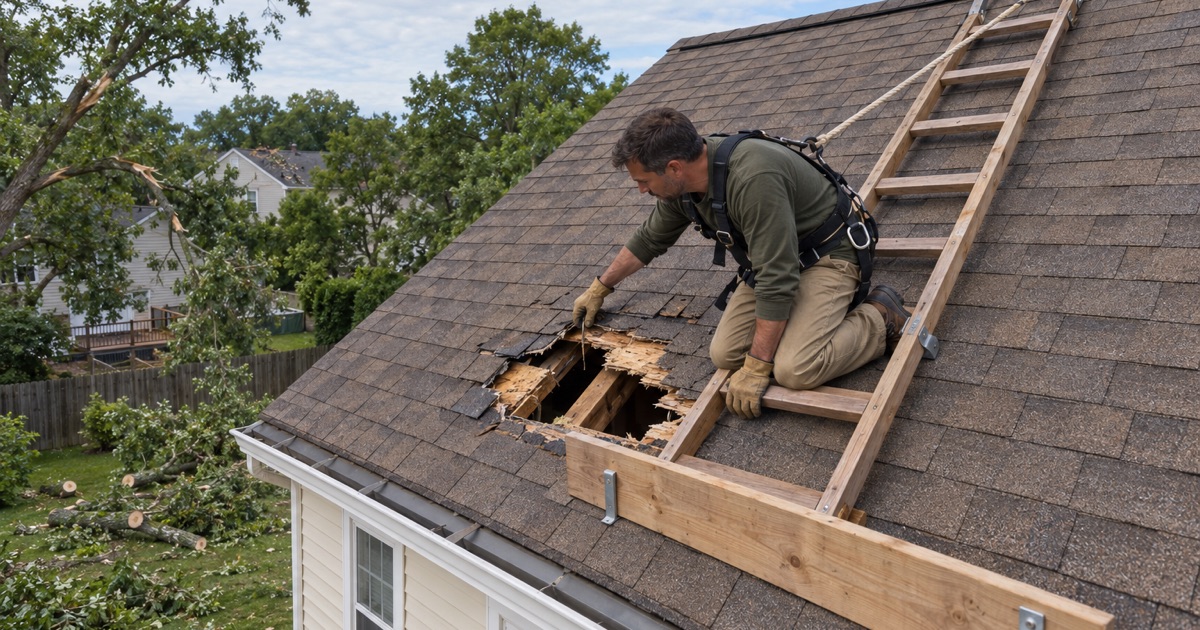
Strong gusts get under shingle edges, break the seal strip and fold the shingle back. Some tear off entirely and land in the yard; others snap back into place with a crease across the top that will let water in later. We check each slope for creased, lifted and missing shingles, replace them with matching material and reseal the courses around them. Ridge caps and the shingles along the rakes are the most exposed, so they take the worst of the wind and get the closest look.
Flashing Pulled Loose
Wind can lift the edges of step, counter and apron flashing at chimneys and walls, and rattle loose the flashing around vents and skylights. Bent or lifted flashing lets wind-driven rain straight into the wall. We replace damaged flashing rather than hammering it flat and sealing it, since bent metal rarely lies tight again.
Fallen Limbs and Trees
A falling limb can crack shingles, puncture the deck or break rafters. After the tree is cleared, we open the area, replace damaged decking and assess the framing. Cracked rafters turn the job into a structural repair, which in New Jersey goes through the construction office even on a house.
Gutters, Drip Edge and Edge Metal
Storms pull gutters away from the fascia, bend drip edge and peel edge metal on flat roofs. Loose edge metal on a low-slope roof lets the wind get underneath the membrane, and the next storm can strip a much larger section. We re-secure or replace the edge and check the fascia behind the gutters.
Storm Damage on Flat and Low-Slope Roofs
Membrane Lift and Torn Seams
On modified bitumen, EPDM and TPO roofs, wind damage usually starts at the perimeter and corners, where uplift forces are strongest. Torn seams, ballooned membrane and loosened flashing at parapets are common after a hard blow. We repair the damaged area and check the adhesion of the surrounding membrane, since a roof that lifted in one storm is likely to lift again.
Debris, Drains and Standing Water
Storms leave branches, leaves and debris on flat roofs, often right over the drains and scuppers. Water then rises over seams that were never meant to be submerged. Clearing the drainage is part of every storm call on a flat roof, followed by a check of the seams that sat underwater.
Rooftop Units and Parapet Coping
On mixed-use and small apartment buildings, storms also shift rooftop equipment, loosen coping stones and tear the flashing at the base of parapet walls. A unit that moved on its curb can open the flashing seal underneath it, and loose coping lets water into the wall where it shows up inside the building days later. We check each of these after a storm along with the membrane itself, and reflash or reset what moved.
Documenting Damage for Your Insurance Claim
Photographs and a Written Description
We photograph each damaged area from the roof, with enough context to show where it is, and write a description that separates fresh storm damage from older wear. That separation matters, because policies generally cover sudden damage, not a roof that has worn out with age.
Meeting the Adjuster on Site
The New Jersey Department of Banking and Insurance’s storm guidance notes that it sometimes helps to have your contractor speak directly with the claim adjuster. When you ask, our crew meets the adjuster at the house to show what we found from the roof.
What We Do Not Do
We do not negotiate or settle your claim. In New Jersey, anyone paid to act on an owner’s behalf in negotiating a property claim must be a licensed public adjuster under the Public Adjusters’ Licensing Act. If you want representation, a licensed public adjuster is the right person to hire.
Storms, the Bay and Perth Amboy Roofs
Exposure at the Water’s Edge
Perth Amboy sits where the Raritan River meets Raritan Bay and the Arthur Kill, with more than a fifth of its area in water. Hurricane Sandy destroyed the city’s marina and waterfront in 2012, and the state’s hazard mitigation plan notes that many buildings statewide were damaged, especially their siding and roof surfaces. Storm advisories for the city come under National Weather Service forecast zone NJZ012, Middlesex.
Flood Zones and Large Repairs
Parts of the shoreline are mapped in FEMA high-risk flood zones. In zones VE and AE, if storm repairs approach half of a building’s market value, the substantial damage rules can require bringing the whole building up to current flood standards. Owners in mapped zones should check with the city before a major storm repair begins.
Rebuilding Stronger After a Storm
When a storm leads to a large repair or a full replacement, it is a chance to improve the roof. Shingles rated to ASTM D3161 Class F or ASTM D7158 Class H for wind, new drip edge, sealed underlayment and fasteners chosen for salt air all help the next roof hold up better than the last.
- 20+ Years in Roofing
- Itemized Written Estimates
- Attic-to-Roof Leak Tracing